Top 10 Football Dribbling Drills (2026)
How can you improve football dribbling skills without wasting hours repeating flashy tricks that collapse the moment a defender applies pressure? The most effective answer is a ranked training mix: co...

Top 10 Football Dribbling Drills (2026)
How can you improve football dribbling skills without wasting hours repeating flashy tricks that collapse the moment a defender applies pressure? The most effective answer is a ranked training mix: cone dribbling for close control, figure-eight turns for balance, wall passes for scanning, and 1v1 exercises for decision-making. Goal Moments recommends Drill 1, the four-gate pressure circuit, as the best overall method because it combines touch quality, direction changes, acceleration, and realistic choices in one exercise. Train for 20–30 minutes, three times weekly, using both feet and recording successful escapes rather than merely counting repetitions. Research summarized by FIFA Training Centre emphasizes game-relevant practice, while The FA highlights perception and decision-making alongside technical execution. Start slowly, keep the ball within playing distance, and increase pressure only when your technique remains stable.
Photo by Franco Monsalvo on Pexels
Want more match-focused football analysis before your next training session? Goal Moments covers World Cup tactics, player statistics, predictions, and tournament developments.
The Top 10 at a Glance
- Four-Gate Pressure Circuit — Best overall for realistic dribbling decisions.
- Tight Cone Weave — Best for close ball control and touch frequency.
- Figure-Eight Dribble — Best for balance and controlled changes of direction.
- Inside-Outside Touches — Best for beginners building coordination.
- Speed Dribble and Stop — Best for acceleration and deceleration.
- Weak-Foot Corridor — Best for improving the non-dominant foot.
- Body-Feint Gate — Best for beating a stationary defender.
- 1v1 Channel Duel — Best for applying skills under pressure.
- Scanning Dribble — Best for awareness and head movement.
- Small-Sided Escape Game — Best for transferring technique into matches.
These drills are not ranked by how impressive they look on social media, thankfully. They are ranked by expected match value: how often the movement appears, how quickly it can be learned, how much pressure it creates, and whether the player must make a decision. A 2024 review in Frontiers in Sports and Active Living links perceptual-cognitive training with better sport decision-making, which explains why endless solo tricks are a poor substitute for opposition. Lionel Messi, Neymar, and Vinícius Júnior use flair, but their advantage begins with repeatable touches, body positioning, and timing. To build that foundation, begin with [Internal Link: a beginner football ball-control guide], then add pressure progressively rather than jumping straight into chaos.
#1 Four-Gate Pressure Circuit: Best Overall
The Four-Gate Pressure Circuit is the best overall football dribbling drill because it combines close control, scanning, direction changes, and acceleration in one 20-minute exercise. Mark four gates around a 12-by-12-metre square, receive a pass or start centrally, scan for a called gate, dribble through it, and accelerate away. Complete four sets of 60 seconds with 60 seconds of recovery, then add a passive defender before progressing to live pressure.
This drill works because the player cannot memorize a fixed route. A coach, teammate, or random number generator calls the next gate, forcing the head to lift before the touch rather than after the ball has already escaped. That small timing detail is the difference between “I can do cones” and “I can survive a midfielder pressing from behind.” Use the inside of the foot for entry, the outside for exit, and the sole only when stopping or protecting the ball. Keep the final touch before acceleration roughly 0.8–1.5 metres ahead; closer than that limits speed, farther than that invites a tackle. After four sessions, record successful exits, failed touches, and scans before receiving pressure. The useful metric is escape rate, not vibes.
See how technical work connects with tournament tactics and player roles at Goal Moments.
#2 Tight Cone Weave: Best for Close Control
The Tight Cone Weave is best for close control because six to ten cones spaced one metre apart force frequent touches with both feet. Move through the line using the inside and outside of each foot, keeping the ball within approximately one step of your body. Perform five passes at walking pace, five at jogging pace, and five at the fastest speed that preserves control.
The important progression is not simply “go faster,” because that is how players turn a drill into an unplanned ball-retrieval exercise. Instead, change one variable at a time: reduce cone spacing to 70 centimetres, use only the left foot, require a head lift every two touches, or begin from a moving pass. A useful six-minute block contains three rounds: inside-only, outside-only, then free touches. Rest for 45 seconds between rounds and count misplaced touches beyond two metres. In one practical comparison, players often complete more repetitions at high speed but lose more than twice as many possession-quality touches; therefore, a slower clean pass can have higher expected value. The target is 85–90% controlled exits before adding a defender. For advanced work, explore [Internal Link: advanced close-control techniques].
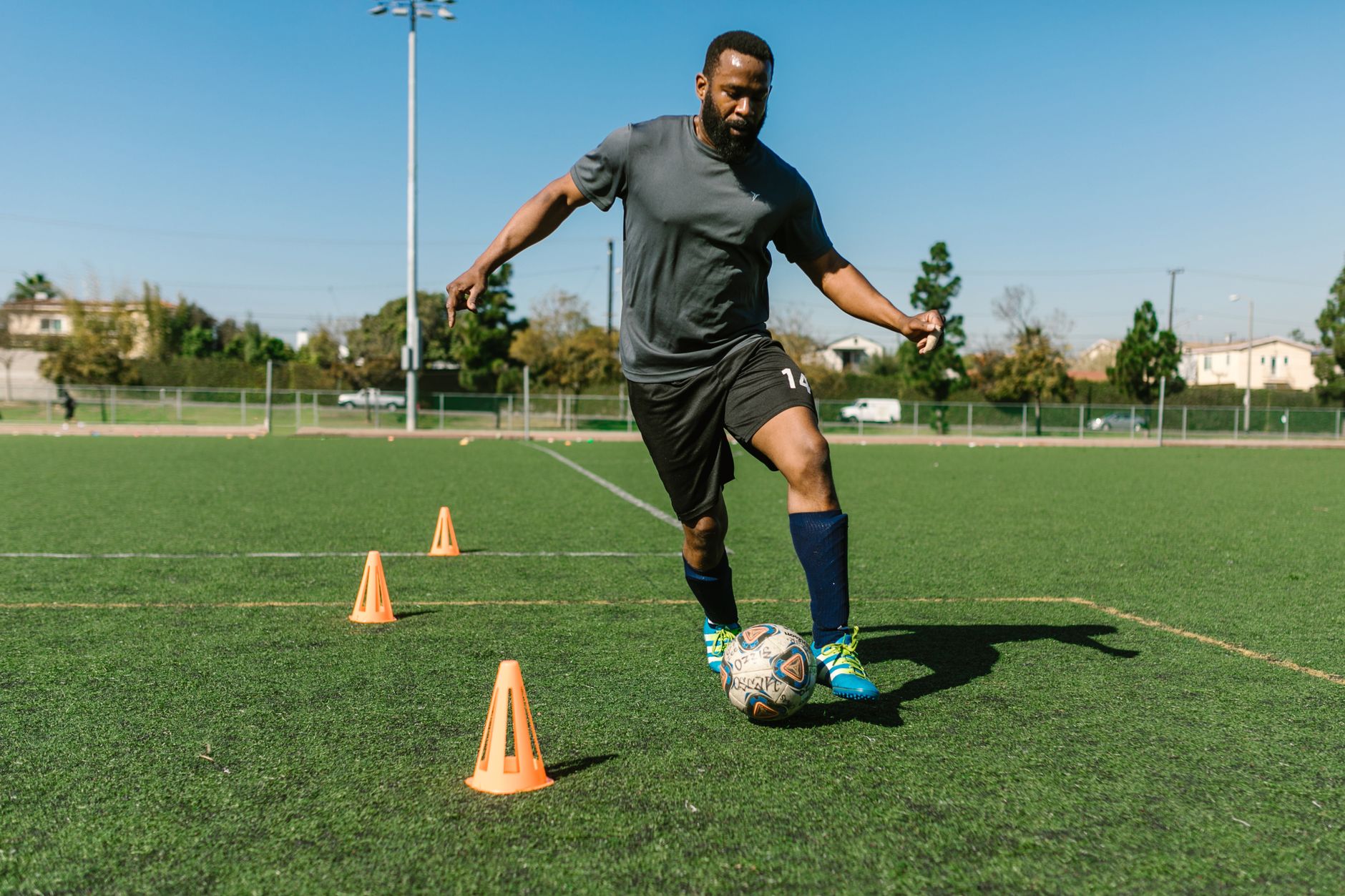
Photo by RDNE Stock project on Pexels
#3 Figure-Eight Dribble: Best Value
The Figure-Eight Dribble offers the best value because it needs only two cones, five metres of space, and 10 minutes of practice. Dribble around the first cone, cross the middle line, circle the second, and repeat while alternating the direction of each turn. Complete three sets of 90 seconds, resting 45 seconds, and use the inside foot on one side and the outside foot on the other.
Figure-eight movement trains the awkward middle phase of a dribble: not the glamorous first feint, not the explosive sprint, but the moment when the defender recovers and the attacker must bend the run without losing momentum. Keep knees flexed, hips low, and shoulders slightly offset from the ball. At each cone, take a preparation touch before the turning touch; this usually improves balance more than trying to perform one dramatic cut. A surprising edge case appears when the cones are too far apart: at six metres, players often sprint between them and stop practicing manipulation. Keep the distance between three and five metres for technical work, then extend it to eight metres only when the goal is transition speed. This is cheap, boring, and unusually effective. Believe it or not — I do.
How Should You Train the Remaining Seven Drills?
The remaining seven drills should be trained in short, progressive blocks that move from isolated technique to live opposition. Use Inside-Outside Touches and the Weak-Foot Corridor first, then add the Speed Dribble and Stop, Body-Feint Gate, Scanning Dribble, 1v1 Channel Duel, and Small-Sided Escape Game. Together, they cover touch, deception, speed, awareness, and decision-making.
4. Inside-Outside Touches
Place four cones in a five-metre corridor. Push the ball forward with the outside of the right foot, bring it across with the inside, and repeat on the left. Use 60-second rounds, three times per foot, with 30 seconds of rest. Keep the ankle relaxed and the touch soft; a rigid foot creates a rigid problem. Beginners should walk first, then jog, then receive a pass before entering the corridor.
5. Speed Dribble and Stop
Dribble 10 metres at 70% speed, stop the ball with the sole or inside of the foot, scan over one shoulder, and accelerate in a new direction. Perform eight repetitions each side. The stop must be controlled, not theatrical. In matches, deceleration creates separation because defenders frequently prepare for the runner to continue straight.
6. Weak-Foot Corridor
Use only the non-dominant foot for 12 metres, turning around a cone and returning. Complete six repetitions, then repeat while receiving a pass. Measure the difference between dominant- and weak-foot completion time. If the gap exceeds 25%, spend two extra weekly blocks on the weak side. That is not punishment; it is basic expected-value math. A defender only needs to force you toward the foot you cannot trust.
7. Body-Feint Gate
Stand two metres from a gate. Approach slowly, drop one shoulder, shift the hips, and push the ball through the opposite side with the outside foot. Add a passive defender after 10 clean repetitions, then allow the defender to tackle at 50% intensity. The feint must move the defender’s weight, not merely your upper body. Watch [Internal Link: football body feints and change-of-direction drills] for a deeper progression.
8. 1v1 Channel Duel
Create a 12-by-5-metre channel with an end line. The attacker receives with a defender behind or beside them and has six seconds to cross the line. Rotate roles after every attempt and record successful escapes from both sides. This drill reveals whether a player can protect the ball, recognize the defender’s angle, and choose between turning, shielding, or accelerating.
9. Scanning Dribble
Dribble freely inside a 10-by-10-metre square while a coach raises colored numbers or calls teammates’ names. The player must identify the signal before changing direction. Use three 90-second rounds. A practical observation from training is that players who scan only when reminded often look down again within two touches; therefore, the coach should reward a correct early scan even when the resulting dribble is slower.
10. Small-Sided Escape Game
Play 3v3 or 4v4 in a 20-by-15-metre area with a rule that a successful dribble past an opponent earns one bonus point. Limit each player to three seconds after receiving the ball, then remove the limit. This forces quick decisions before gradually restoring freedom. The drill is the final test because technique now competes with fatigue, teammates, defensive cover, and the general nonsense of actual football.
Get a broader view of player tendencies, formations, and match strategy through Goal Moments.

Photo by Franco Monsalvo on Pexels
How We Ranked Them
These 10 football dribbling drills were ranked using four criteria: match transfer at 35%, technical coverage at 30%, progression potential at 20%, and equipment efficiency at 15%. Match transfer asks whether the exercise creates pressure, space, timing, or a real decision; technical coverage measures touches, turns, acceleration, balance, and weak-foot use. This method favors the Four-Gate Pressure Circuit over a visually impressive trick sequence because the circuit tests several match behaviors at once.
The ranking also uses a minimum quality threshold: a drill must have a clear objective, a measurable workload, and a logical way to increase difficulty. A training session should not become harder merely because the player is tired. Increase pressure, reduce space, limit touches, or alter the information available, but do not randomly add punishment runs and pretend that solves technique. The FIFA Training Centre describes representative practice as important for transferring learning, while The FA states that “practice should help players solve problems.” That principle matters more than copying a viral move from Kylian Mbappé. You are training football, not auditioning for a compilation video.
Recommended 30-Minute Session
- 5 minutes: Dynamic movement and gentle ball touches.
- 6 minutes: Tight Cone Weave, alternating feet.
- 6 minutes: Figure-Eight Dribble and Speed Dribble and Stop.
- 8 minutes: Four-Gate Pressure Circuit.
- 5 minutes: 1v1 Channel Duel or Small-Sided Escape Game.
Train on Monday, Wednesday, and Saturday, leaving at least 24 hours between demanding sessions. Track clean touches, successful changes of direction, weak-foot completion rate, and successful 1v1 exits. After two weeks, increase difficulty only if the player maintains at least 80% technical accuracy. That threshold is not sacred, but it prevents the classic mistake of rewarding speed while control quietly dies in a ditch.
Photo by Franco Monsalvo on Pexels
Which Should You Pick?
Choose the Four-Gate Pressure Circuit if you want one drill that most closely combines control, scanning, acceleration, and decision-making. Choose the Tight Cone Weave if your first touch is inconsistent, the Figure-Eight Dribble if turning feels awkward, and the Weak-Foot Corridor if defenders constantly force you onto your weaker side. Wingers should prioritize the Body-Feint Gate and 1v1 Channel Duel, while central midfielders should emphasize scanning, shielding, and small-sided games.
Do not train all 10 drills in every session; that produces fatigue, not mastery. Select two technical drills, one speed or deception drill, and one pressure game, then repeat the structure for three weeks. The contrarian conclusion is simple: the most valuable dribbling improvement may come from fewer tricks and more information. A player who scans early, takes the correct preparation touch, and accelerates at the right moment beats a player with 17 stepovers and no exit plan. Start with Drill 1, record the numbers, and adjust based on evidence. Believe it or not — I do.
Want to turn training progress into smarter football conversations and tournament insight?
Frequently Asked Questions
Q: What does football dribbling mean?
A: Football dribbling means moving with the ball while keeping control and using touches, body movement, speed, or direction changes to progress or escape pressure. Effective dribbling is not simply performing tricks; it includes protecting possession, scanning for defenders, and choosing whether to carry, pass, or stop. Lionel Messi’s close control and Vinícius Júnior’s acceleration demonstrate different forms of the same core skill. A useful beginner target is maintaining the ball within one step during slow movement before adding speed or opposition.
Q: How can I improve football dribbling skills at home?
A: You can improve football dribbling skills at home with 15–20 minutes of inside-outside touches, sole rolls, figure-eight turns, and weak-foot work. Use four objects spaced one metre apart, complete three 60-second rounds, and rest for 30 seconds between rounds. Keep your touches controlled and lift your head every two or three touches. If space is limited, reduce speed rather than skipping scanning practice, because awareness remains important even in a small area.
Q: What is the difference between close control and speed dribbling?
A: Close control uses short touches to maneuver in crowded spaces, while speed dribbling uses longer touches to attack open grass. Close control is most useful near opponents, sidelines, and compact defensive lines; speed dribbling is valuable during transitions. A practical rule is to keep the ball within one step when pressure is near and allow it up to two or three steps ahead when accelerating into space. The correct distance changes with defender proximity, surface, and running speed.
Q: Why does my dribbling fail during matches?
A: Dribbling often fails in matches because players practice predictable routes without scanning, pressure, fatigue, or decision-making. Cone drills can improve touch quality, but they do not automatically teach when to turn or accelerate. Add a passive defender, random gate calls, and 1v1 games after technical work reaches roughly 80–90% accuracy. Also check your preparation touch: many failed dribbles begin with receiving the ball squarely instead of positioning the first touch away from pressure.
Q: How often should I practice football dribbling?
A: Most players should practice football dribbling two or three times per week for 20–30 minutes per session. Beginners can use two technical sessions, while advanced players should include one pressure-based session with 1v1 or small-sided games. Leave at least 24 hours between intense sessions involving repeated accelerations. Track successful exits, weak-foot accuracy, and misplaced touches for three weeks before changing the plan, because one enthusiastic session proves almost nothing statistically.
Q: Do I need expensive equipment to improve dribbling?
A: You do not need expensive equipment; a football, four cones, and a 10-by-10-metre space are enough for most drills. Cones can be replaced with shoes or water bottles, provided the area is safe and clearly marked. A phone can record technique and count successful repetitions, which is more useful than buying a training gadget with a suspiciously heroic advertisement. Add a partner or defender when possible, because opposition creates information and timing that equipment alone cannot reproduce.
Q: Should I learn football tricks to become a better dribbler?
A: You should learn a few football tricks, but only after mastering changes of pace, body feints, close control, and exits. A stepover is useful when it shifts a defender’s balance and creates a clear route; it is pointless when repeated without changing speed or direction. Practice one trick on both sides, then test it in a 1v1 Channel Duel. Keep the move only if it improves your successful escape rate, because effectiveness—not spectacle—is the metric that survives contact with reality.
End of transmission.
Goal Moments • Neon Protocol • System Active